ZScaler: Achieving Zero Trust in Computer Networks

Following my previous post about the Zero Trust security model, I like to introduce ZScaler and also emphasize that implementing Zero Trust is not an easy feat, and it requires a comprehensive approach that involves people, processes, and technology. ZScaler is a cloud-based security solution that has been designed to help organizations achieve Zero Trust in their computer networks.

ZScaler is a cloud-native security platform that provides secure access to the internet and internal applications. ZScaler uses a Zero Trust architecture that assumes no user or device is trustworthy, and all network traffic must be inspected and verified before being allowed access. ZScaler achieves Zero Trust through its comprehensive security features, which include:

  1. Multi-factor authentication: ZScaler provides a multi-factor authentication (MFA) solution that ensures that only authorized users can access corporate resources. The MFA solution supports various authentication methods, including SMS, email, and mobile apps.
  2. Network segmentation: ZScaler segments the network into multiple zones and enforces access control policies based on the principle of least privilege. This approach limits the attack surface and prevents lateral movement within the network.
  3. Secure access service edge (SASE): ZScaler provides a SASE solution that delivers security and networking capabilities as a cloud service. SASE consolidates networking and security functions, making it easier for organizations to manage and secure their network infrastructure.
  4. Real-time monitoring and analytics: ZScaler provides real-time monitoring and analytics to detect and respond to any suspicious activity or anomalies. This approach helps organizations identify and mitigate potential threats before they cause significant damage.
  5. Encryption: ZScaler provides end-to-end encryption for all network traffic, ensuring that data is protected in transit. Encryption also prevents eavesdropping and man-in-the-middle attacks.

ZScaler’s Zero Trust architecture is based on the principle of “never trust, always verify.” ZScaler ensures that all network traffic is inspected and verified, regardless of its source or destination. This approach reduces the attack surface and limits the impact of a potential breach.

Implementing Zero Trust is not easy, and it requires a comprehensive approach that involves people, processes, and technology. ZScaler’s cloud-native security platform provides a comprehensive solution that helps organizations achieve Zero Trust in their computer networks. With ZScaler, organizations can be assured that their network infrastructure is secure, and their critical assets are protected.
Zero Trust: The Future of Network Security

In today’s ever-evolving technological landscape, cyber threats have become a common problem for organizations worldwide. With the rise of remote work and cloud computing, traditional perimeter-based security models are becoming increasingly inadequate. The Zero Trust security model is a new approach that addresses these shortcomings and offers a more robust and effective solution for securing computer networks.

The concept of Zero Trust was first introduced by John Kindervag, a former analyst at Forrester Research, in 2010. Zero Trust is a security model based on the principle of “never trust, always verify.” In other words, it assumes that no user or device is trustworthy, regardless of whether they are inside or outside the organization’s network. Every user, device, and network connection must be authenticated, authorized, and verified before being granted access to any resource.

The Zero Trust security model is designed to address the limitations of traditional perimeter-based security models. Perimeter-based security assumes that everything inside the network is trusted and everything outside is not. However, this model is no longer adequate because users are now accessing corporate resources from various locations, devices, and networks, making it difficult to establish a clear perimeter.

Zero Trust, on the other hand, assumes that the network has already been breached or will be breached at some point. Therefore, every device and user must be continuously authenticated and verified before being granted access to any resource. This approach reduces the attack surface and limits the impact of a potential breach.

The Zero Trust security model is based on five core principles:

  1. Verify and authenticate every user and device before granting access to any resource.
  2. Limit access based on the principle of least privilege, which means giving users access only to the resources they need to perform their job.
  3. Assume that all networks, whether internal or external, are untrusted.
  4. Monitor and log all network activity to detect and respond to any suspicious behavior or anomalies.
  5. Apply security policies consistently across all devices, networks, and applications.

Implementing a Zero Trust security model requires a comprehensive approach that involves people, processes, and technology. Organizations need to identify all their assets, map out their network topology, and assess their risk posture. They need to implement multi-factor authentication, network segmentation, and access controls based on the principle of least privilege. They also need to monitor and log all network activity, use encryption and apply security policies consistently across all devices, networks, and applications.

In conclusion, the Zero Trust security model is a new approach that offers a more robust and effective solution for securing computer networks. By assuming that no user or device is trustworthy, it reduces the attack surface and limits the impact of a potential breach. Organizations that adopt Zero Trust will be better equipped to defend against cyber threats and protect their critical assets.

Web Assembly: The Future of Web Development

Web development has come a long way since the early days of static HTML pages. Today, web applications are becoming increasingly complex, and users expect fast and responsive experiences. With the rise of web technologies like JavaScript and HTML5, developers have been able to create rich web applications that rival traditional desktop software. However, even with these advancements, web applications can still suffer from performance issues.

Enter Web Assembly (WASM), a new technology that promises to revolutionize web development by offering near-native performance for web applications. In this blog post, we’ll look at what Web Assembly is, how it works, and why it’s being touted as the future of web development.

What is Web Assembly?

Web Assembly is a binary format for executing code on the web. It was first introduced by Mozilla in 2015, and it has since gained support from all major browsers, including Google Chrome, Microsoft Edge, and Safari. Web Assembly allows developers to write code in languages other than JavaScript, such as C++, Rust, and Go, and run that code directly in the browser.

How does Web Assembly work?

Web Assembly code is compiled from a higher-level programming language into a binary format that can be executed by the browser. This means that developers can write code in their language of choice, compile it to Web Assembly, and then run that code in the browser without the need for an interpreter or virtual machine.

Because Web Assembly is designed to be platform-agnostic, it can run on any device with a compatible browser, including smartphones, tablets, and desktop computers. This makes it a powerful tool for creating cross-platform applications that work seamlessly across all devices.

Why is Web Assembly the future of web development?

Web Assembly offers several advantages over traditional web development technologies like JavaScript. Here are some of the key reasons why it’s being touted as the future of web development:

  1. Performance: Web Assembly offers near-native performance for web applications, which means that applications can run faster and more efficiently than ever before. This is particularly important for applications that require a lot of processing power, such as games and video editing software.
  2. Language choice: With Web Assembly, developers can choose the programming language that best suits their needs, rather than being limited to JavaScript. This can lead to more efficient and maintainable code, as well as a larger pool of developers who can contribute to the project.
  3. Cross-platform compatibility: Because Web Assembly can run on any device with a compatible browser, it’s a powerful tool for creating cross-platform applications that work seamlessly across all devices.
  4. Security: Web Assembly provides a sandboxed execution environment that isolates code from the rest of the system. This makes it more difficult for attackers to exploit vulnerabilities in the code and compromise the security of the application.
  5. Accessibility: Because Web Assembly is designed to be platform-agnostic, it can run on a wide variety of devices, including those with low processing power or limited memory. This makes it more accessible to users who may not have access to high-end hardware.

Web Assembly is a game-changer for web development, offering near-native performance and cross-platform compatibility that was previously impossible with traditional web technologies. While it’s still a relatively new technology, it’s quickly gaining traction among developers who are looking for ways to build faster and more efficient web applications. As more developers begin to adopt Web Assembly, we can expect to see a new generation of web applications that are faster, more responsive, and more accessible than ever before.

CloudFlare and its role is modern day web applications

If you have a website, you know how important it is to make sure it runs fast, smoothly, and securely. You want to provide a great user experience for your visitors and customers and protect your site from hackers and malicious attacks. But how can you achieve that without spending a lot of time and money on web development and maintenance?

That’s where Cloudflare comes in. Cloudflare is a company that provides web performance and security services for websites, APIs, and Internet applications. It has a global network of servers that help optimize the delivery of web content and protect against online threats. Cloudflare offers different plans for different needs, ranging from free to enterprise-level.

In this blog post, we will explain the benefits of Cloudflare for your website and how to get started with it. We will cover the following topics:

– How Cloudflare works as a reverse proxy and a content delivery network

– How Cloudflare improves your website’s speed, reliability, and security

– How Cloudflare helps you save bandwidth and reduce costs

Cloudflare is a powerful and easy-to-use service that can improve your website’s performance and security in many ways. By acting as a reverse proxy and a content delivery network, Cloudflare can optimize the delivery of your web content and protect it from online threats.

A reverse proxy is a server that sits in front of web servers and forwards client requests to those web serversA content delivery network (CDN) is a network of servers that can deliver web content faster by caching it on edge servers near users.

By reducing the bandwidth and costs of your origin server, Cloudflare can help you save money and resources. By providing analytics and insights on your web traffic and performance, Cloudflare can help you make better decisions for your online business.

In a nutshell, Some of the benefits of Cloudflare are:

  • It caches your static assets on its servers, reducing your server load and bandwidth consumption.
  • It has a worldwide content delivery network (CDN) that delivers your web content faster to users across different locations.
  • It protects your site from brute-force attacks, DDoS attacks, malicious bots, email harvesting, etc. by filtering requests and identifying threats.
  • It offers free SSL certificates, which encrypt your traffic and improve your site’s ranking and trustworthiness.
  • It has a web application firewall (WAF) that blocks common web vulnerabilities and updates its ruleset automatically.
  • It has a RocketLoader feature that optimizes your JavaScript resources for faster loading.
  • It has a Workers platform that allows you to deploy serverless code across its network.

If you want to enjoy these benefits and more, you can sign up for Cloudflare today and set it up for your website in minutes. You can choose from different plans that suit your needs and budget. You can also customize your settings on Cloudflare’s dashboard according to your preferences.

Cloudflare is trusted by millions of websites around the world, including some of the most popular ones like Reddit, Shopify, Medium, Discord, and many more.

AI and its role in software development

AI, or artificial intelligence, is the ability of machines to perform tasks that normally require human intelligence, such as reasoning, learning, decision making, and creativity. AI has been transforming various industries and domains, including software development. In this blog post, we will explore how AI can help software developers become more efficient, effective, and innovative.

AI can assist software developers in various stages of the software development process, such as project planning and estimation, user experience design, code generation and optimization, quality testing, and deployment. AI can also enable software developers to create new types of applications that leverage natural language processing (NLP), computer vision (CV), speech recognition (SR), and machine learning (ML).

Some examples of how AI can improve software development are:

AI is not only a tool for software development but also a domain for software innovation. Software developers can use AI techniques to create new types of applications that solve complex problems or provide novel experiences. Some examples of such applications are:

  • NLP applications: These are applications that use natural language processing techniques to understand or generate natural language texts or speech. Examples include chatbots, text summarizers, sentiment analysers, etc.
  • CV applications: These are applications that use computer vision techniques to analyse or manipulate images or videos. Examples include face recognition, object detection, image editing, etc.
  • SR applications: These are applications that use speech recognition techniques to transcribe or synthesize speech signals. Examples include voice assistants, speech translators, speech synthesizers, etc.
  • ML applications: These are applications that use machine learning techniques to learn from data or perform predictions or classifications. Examples include recommender systems, fraud detection systems , self-driving cars, etc .

AI is changing the way software is developed and what software can do. Software developers need to embrace AI as an opportunity to enhance their skills, productivity, creativity, and innovation. By using AI tools, they can streamline their processes, reduce waste, and deliver high-quality solutions. By creating AI applications, they can solve challenging problems, provide new value, and delight their users.

How Microsoft, Google, and Amazon Are Increasing Their Investment in Cloud Infrastructure

Cloud infrastructure is a booming industry that is expected to grow from $233 billion in 2019 to $623 billion by 2023. The demand for cloud services is driven by the increasing adoption of digital transformation, artificial intelligence (AI), Internet of Things (IoT), big data analytics, and other emerging technologies across various sectors.

Among the cloud providers, three companies stand out as the dominant players: Microsoft, Google, and Amazon. These companies account for 61% of all cloud infrastructure spending as of 2021’s second quarter. Amazon Web Services (AWS) controls 31% of the market share,

while Microsoft Azure has 22% and Google Cloud has 8%.

How are these three companies increasing their investment in cloud infrastructure? Here are some of the key strategies and initiatives they are pursuing:

Expanding global data center footprint: All three companies are investing heavily in building and expanding their data centers around the world to meet the growing demand for cloud services. According to a report by Synergy Research Group, Amazon, Microsoft, and Google collectively operate more than 50% of the world’s largest data centers across 24 countries. In 2020 alone, these companies spent over $40 billion on capital expenditures related to data centers.

Developing new cloud products and services: All three companies are constantly innovating and launching new cloud products and services to cater to different customer needs and use cases. For example, Microsoft offers Azure Arc, a hybrid cloud solution that allows customers to manage their resources across multiple clouds and on-premises environments. Google offers Anthos, a platform that enables customers to run their applications anywhere using Kubernetes. Amazon offers AWS Outposts, a service that delivers AWS infrastructure and services to customers’ premises for low-latency applications.

Focusing on specific verticals and segments: All three companies are also targeting specific verticals and segments that have high potential for cloud adoption and growth. For example, Microsoft focuses on enterprise customers

and offers industry-specific solutions for healthcare, retail, manufacturing and financial services. Google focuses on AI and machine learning (ML) customers and offers tools like TensorFlow and AutoML for building and deploying AI models. Amazon focuses on e-commerce and consumer customers and offers services like Prime Video and Alexa for delivering content and voice assistance.

Conclusion

Cloud infrastructure is a highly competitive and dynamic market that is dominated by three tech giants: Microsoft, Google and Amazon. These companies are increasing their investment in cloud infrastructure by expanding their global data center footprint, developing new cloud products and services, focusing on specific verticals and segments. By doing so, they aim to capture more market share, attract more customers, drive more revenue, and gain more competitive advantage.

Cloud Computing Trends for 2023

Cloud computing has become an essential part of the digital transformation journey for many organizations. As cloud services and platforms continue to innovate and expand, we can expect to see some exciting trends emerging in 2023. Here are some of the key cloud computing trends that will shape the future of business and technology.

  1. Powering hybrid workers
    The COVID-19 pandemic has accelerated the shift to remote and hybrid work models, which rely heavily on cloud-based tools and solutions. Cloud computing enables workers to access data, applications, and collaboration tools from anywhere, anytime, and on any device. In 2023, we can expect to see more cloud solutions that cater to the needs and preferences of hybrid workers, such as enhanced security, productivity, mobility, and flexibility.
  2. Cloud sustainability
    As environmental concerns become more urgent and prominent, cloud computing can play a vital role in reducing carbon emissions and energy consumption. Cloud providers are investing in renewable energy sources, green data centers, carbon offsetting programs, and other initiatives to make their operations more sustainable. Cloud customers can also benefit from lower costs, improved efficiency, and better compliance by choosing green cloud solutions.
  3. AI adoption boosts cloud growth
    Artificial intelligence (AI) is one of the most powerful technologies that can leverage cloud computing capabilities. AI applications require large amounts of data, processing power, storage space, and scalability that cloud services can provide. In 2023, we can expect to see more businesses adopting AI solutions powered by cloud platforms to enhance their operations, customer experience,
    innovation, and competitiveness.
  4. Enterprises embrace sovereign clouds
    Sovereign clouds are cloud services that are operated within a specific country or region under its laws and regulations. They offer greater data sovereignty, security, privacy, and compliance for customers who have sensitive or regulated data or operations. In 2023, we can expect to see more enterprises opting for sovereign clouds, especially in regions like Europe, Asia, and Africa, where data protection laws are stricter or vary widely.
  5. XaaS matures
    XaaS stands for Everything as a Service, which refers to the delivery of various IT services over the internet through cloud platforms. XaaS includes Software as a Service (SaaS), Platform as a Service (PaaS), Infrastructure as a Service (IaaS), and many other types of services such as Security as a Service (SECaaS), Data as a Service (DaaS), and Blockchain as a Service (BaaS). In 2023, we can expect to see XaaS becoming more mature, diverse,
    and customized, offering customers more choices, flexibility, and value.

Conclusion
Cloud computing is not only a trend but also a necessity for businesses in the digital age. In 2023, we can expect to see more innovations, challenges, and opportunities in this dynamic field. Businesses that want to stay ahead of the curve should keep an eye on these trends and adopt cloud solutions that suit their goals and needs.

Social Robots in Education: A Promising Tool for Students with Learning Disabilities

Technology has become an essential part of our daily lives, and it has also made significant inroads into education. With the help of artificial intelligence and machine learning, educators have been exploring new ways to enhance learning for students with disabilities. In a recent study conducted by the University of Waterloo and the Learning Disabilities Society in Vancouver, social robots have been found to be a promising tool for students with learning disabilities.

The study, led by Dr. Kerstin Dautenhahn, a professor of electrical and computer engineering, involved testing a small humanoid robot called QT on 16 students with learning disabilities. The researchers divided the students into two groups. In one group, students worked one-on-one with an instructor only. In the other group, the students worked one-on-one with an instructor and a QT robot.

The robot’s ability to perform gestures using its head and hands, accompanied by its speech and facial features, makes it very suitable for use with children with learning disabilities. The robot was controlled by the instructor using a tablet, which directed the robot to autonomously perform various activities using its speech and gestures. The instructor triggered the robot to lead the student, who introduced the session, set goals, and provided self-regulating strategies if necessary.

The robot also used strategies such as games, riddles, jokes, breathing exercises, and physical movements to redirect the student back to the task if the learning process was getting off-track. Students who worked with the robot were “generally more engaged with their tasks and could complete their tasks at a higher rate compared” to the students who weren’t assisted by a robot.

The researchers concluded that the use of robots in public education systems has great potential, and the findings imply that robots have a positive effect on students. Dr. Dautenhahn has been working on robotics in the context of disability for many years and incorporates principles of equity, inclusion, and diversity in research projects.

While most research on the use of social robots in education has focused on children with Autism Spectrum Disorder, little work has been done on the use of socially assistive robots for students with learning disabilities. The researchers plan to conduct further studies using the QT robot and explore its potential for enhancing learning for students with disabilities.

In conclusion, social robots have the potential to revolutionize the way we approach education for students with learning disabilities. By providing additional learning support, such as one-on-one instruction, and using the latest technology, such as social robots, educators can create a more engaging and effective learning experience for students with disabilities. With further research and development, social robots could become a valuable tool in the classroom, helping students with disabilities achieve their full potential.

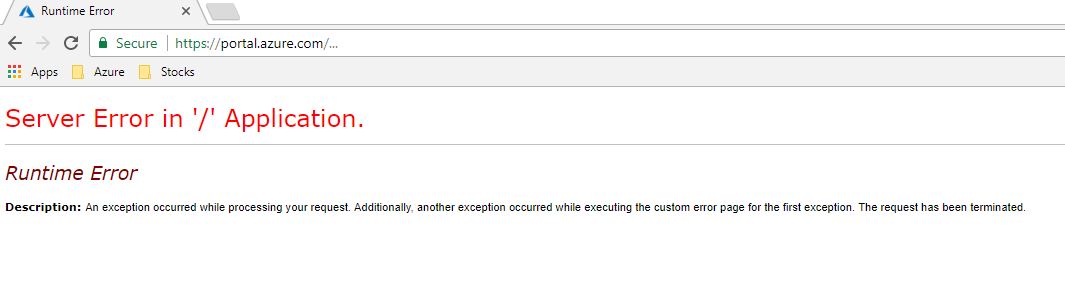
YSOD on Azure Portal Home Page


amzn_assoc_ad_type = “banner”;
amzn_assoc_marketplace = “amazon”;
amzn_assoc_region = “US”;
amzn_assoc_placement = “assoc_banner_placement_default”;
amzn_assoc_campaigns = “software”;
amzn_assoc_banner_type = “category”;
amzn_assoc_p = “21”;
amzn_assoc_isresponsive = “false”;
amzn_assoc_banner_id = “040CAFM9HWSCJ6A03YR2”;
amzn_assoc_width = “125”;
amzn_assoc_height = “125”;
amzn_assoc_tracking_id = “logitex-20”;
amzn_assoc_linkid = “a857db38d5cfe3e614a81de9cfe45656”;

//z-na.amazon-adsystem.com/widgets/q?ServiceVersion=20070822&Operation=GetScript&ID=OneJS&WS=1

AzurePortalGenericErrorPage

Control Azure cost using PowerBI

Recently we decided to have a look at our Azure costs and rationalize what was costing us our hard-earned dollars each month. Having around 800 staff with some of them creating Azure resources for development purposes and forgetting to stop/remove them when they were not needed was a string reason to get the cost under control. If your organization is big with lots of people being able to create Azure resources, it is recommended that you start looking at Azure policies. The purpose of Azure policies is to restrict what the users in the organizations can create. One example would be to limit the VM sizes users can create to the sizes you can afford. You can read about Azure policies here.

Coming back to the topic of keeping an eye on your day to day Azure costs, there is a very handy service in PowerBI you can utilize. The steps are very simple:


1- Log in to PowerBI website or launch PowerBI desktop (downloadable from here)

2- Click on Get Data and then under Services click on Get 


AzureCostPowerBI1

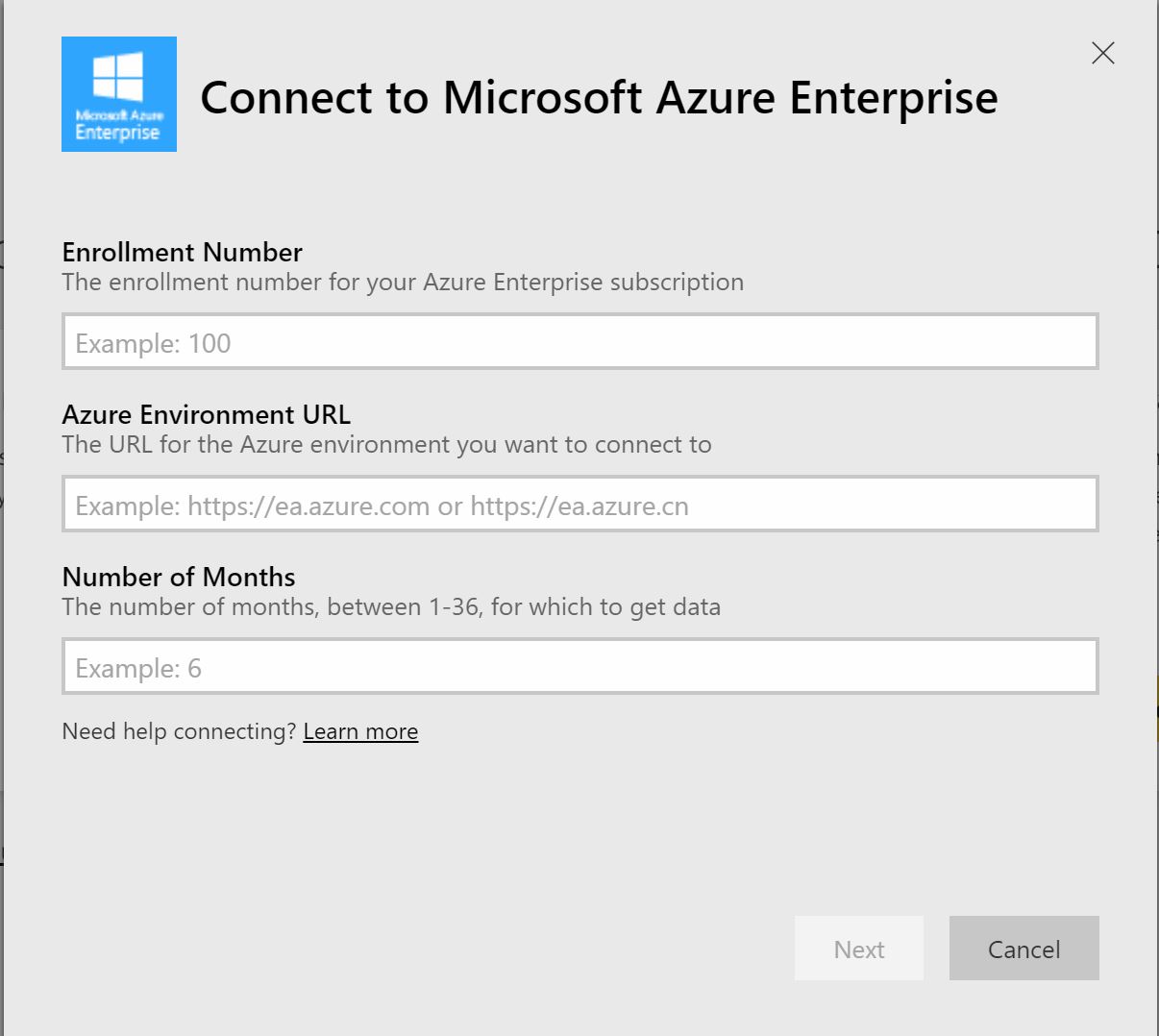
3- From the list of apps that appear, find “Microsoft Enterprise Azure” and click on “Get it now. A new window opens and asks you to identify your environment:


AzureCostPowerBI2

4- To retrieve your Enrollment Number you need to log in to your enterprise portal accessible at https://ea.azure.com. Once you logged in the number is displayed at the top of the screen:

AzureCostPowerBI3

5- For Environment URL provide “https://ea.azure.com” and for the number of months provide a number (I could not personally get more that 6 month’s worth of consumption data).

6- That’s it! You will be taken to a dashboard created by PowerBI giving you a lot of information.


P.S: This is not a PowerBI guide but one feature that I particularly like is the QA feature. Once your usage data is loaded into PowerBI, you can use natural language to query your usage and PowerBI will show a Chart, a number, a table or a string based on the nature of your query. For instance, I was interested to know what resource group was costing us the most so I typed a query like: “cost of last month by resource group” and was represented with a chart like this. Easy! I’ll let you take your imagination and take this further.

AzureCostPowerBI4

P.S #2: Another feature that I particularly liked was the ability to monitor a data field inside PowerBI, and what better metric to monitor than the cost itself! My idea was to set up an alert on yesterday’s cost and see if has spiked to an amount that requires intervention! This was to not let it run until the end of them month and create a bill shock but rather send an email so something can be done. This was achieved by clicking on the cost tile on the dashboard and creating an alert for the data field:

AzureCostPowerBI5


There was a small problem with the data coming from Azure and yesterday’s cost was not synced and the amount was lower than I expected. What I did was changed it to the cost of two day’s ago by editing the tile.